


The lesson could not be clearer: economic progress and military strength are not separate domains.
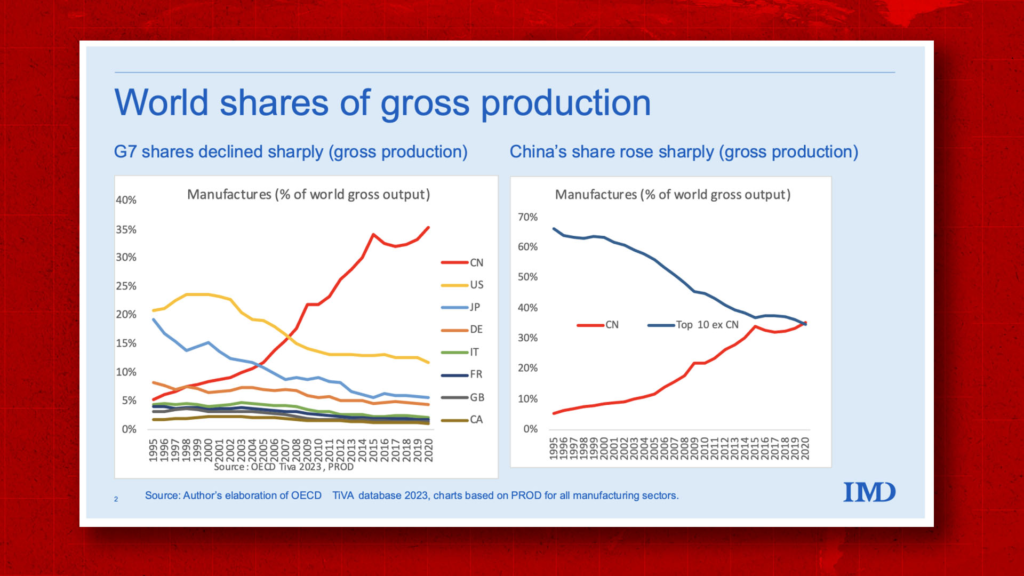
China’s rapid ascent in the automobile industry and its swift advances in other sectors—such as aircraft manufacturing, semiconductors, and high-technology industries—mark one of the most significant economic transformations of the twenty-first century. Through companies like COMAC, which is now producing the C909 and C919 passenger jets, China is challenging Western dominance in domains that have long been considered exclusive preserves of the United States and Europe. Simultaneously, its breakthroughs in semiconductor design and manufacturing, despite stringent Western sanctions, signal a determination to achieve technological self-sufficiency across the board. The scale of this transformation is staggering: China currently accounts for approximately 35% of global manufacturing output, a figure greater than the combined production of the United States, Germany, India, and Japan—the next four largest manufacturing powers on earth.
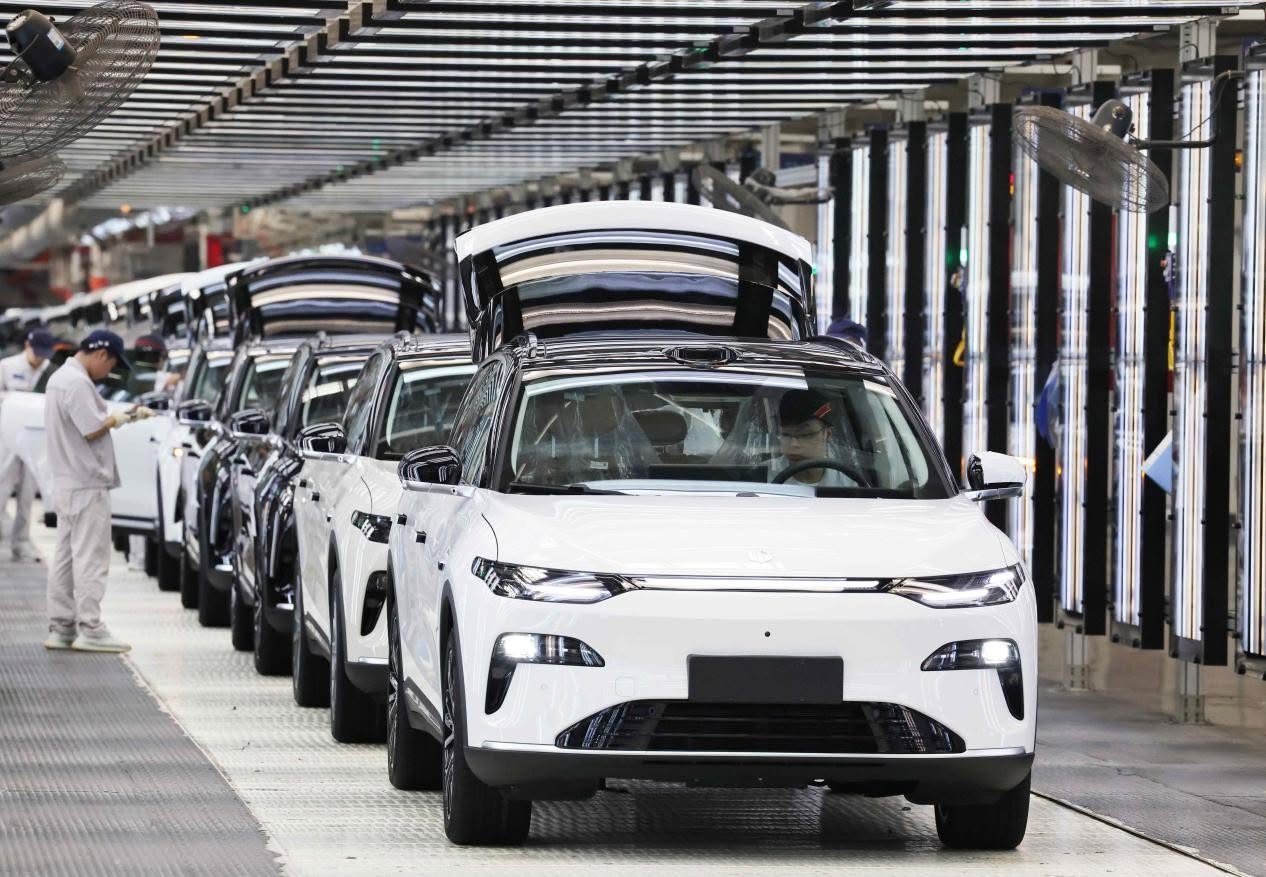
This economic ascendancy has not gone unnoticed. Across the Western world, hawkish sentiments are intensifying, particularly in response to China’s extraordinary inroads into the automotive industry. Chinese electric vehicle manufacturers have not only come to dominate their domestic market but have also launched a sustained assault on global markets, beginning with the Global South and now penetrating Europe itself. European automotive giants like Volkswagen, BMW, and Stellantis—companies that once commanded unchallenged supremacy—are now being forced into defensive partnerships with Chinese firms such as Leapmotor. The South China Morning Post recently reported that Germany, historically the heartland of European automobile manufacturing, is becoming increasingly hawkish toward China as it watches its industrial crown jewels slip away. The displacement of long-established Western automakers and the growing threat to Japanese stalwarts like Toyota underscore a fundamental shift in the global balance of industrial power.
This is no accident. China has been preparing for this moment for decades, pursuing a deliberate, state-driven strategy of industrial upgrading. But China has not limited its preparations to the economic sphere. It has simultaneously expanded its defence budget, modernised its military, and positioned itself to confront any attempt to roll back its gains. The Chinese are not foolish; they understand that economic dominance without military capability is vulnerable. And for those who study the rise and fall of nations, the parallels with history are instructive.
It is worth recalling the period of the Century of Humiliation, when Western powers—led by Britain, later joined by Germany, the United States, and others—ganged up against a declining Qing dynasty. The underlying cause of that aggression was not dissimilar to today’s dynamics: China had long dominated the global economy and produced goods the West desperately wanted—tea, silk, porcelain—while the West had little to offer in return. Unable to compete fairly, Britain resorted to force, using opium to prise open Chinese markets and impose a system of unequal treaties. That pattern of Western desperation, coercion, and military intervention in the face of commercial frustration is now repeating itself. The hawkish rhetoric emerging from both European capitals and Washington carries the same underlying anxiety: a declining hegemon watching its economic supremacy erode and contemplating drastic measures to preserve it.
These hawkish sentiments are not confined to political circles. They have also taken root among Western intellectuals who have long advanced the narrative that the Western model—liberal democracy combined with free-market capitalism—is the only viable path to economic prosperity. For decades, these intellectuals sought to equate economic progress with particular forms of political organisation, insisting that any nation wishing to develop must adopt Western-style governance. China’s rise has shattered that claim. It has demonstrated that economic modernisation can proceed along a different path, one shaped by national conditions, state direction, and strategic planning. The collapse of this ideological certainty has given way to bitterness. Recently, one such intellectual wrote in the Financial Times, with undisguised frustration, that China has made trade impossible because it manufactures everything. The complaint itself reveals the depth of Western anxiety: when the system you designed no longer guarantees your victory, you denounce the system.
This convergence of political and intellectual desperation is precisely the reason China must remain awake and alert. It is not enough to prepare militarily, though that is essential. History teaches that declining powers, when confronted with the erosion of their economic fortunes, often translate domestic frustration into foreign aggression. The West, having lost control of the global pillars of industrial progress—most notably the automobile industry—may well be tempted to launch a full-blown war against China in an attempt to harvest its economy, destroy its industries, and impose a dysfunctional governance model similar to those it has installed across much of the Global South. China must therefore be prepared not only to defend itself but also to calibrate its approach, allowing the West small victories where possible to make the inevitable decline less painful and less likely to provoke reckless military adventurism.
For Africa, observing these developments from the sidelines offers a profound and urgent lesson. The doctrines preached to the continent by the West—comparative advantage, open markets, political liberalisation as a precondition for development—have been exposed as instruments of convenience, advanced when they served Western interests and abandoned the moment they ceased to do so. Africa must recognise that what has been presented as universal economic wisdom is, in reality, a mechanism for perpetuating exploitation. The current political and economic organisations inherited from colonialism have been used by imperial powers to continue the extraction of African wealth, much as they did in the days of slavery and formal colonialism. Africa must now be bolder in exploring new political and economic directions, rejecting the notion that development must follow a Western blueprint and embracing instead the principle that sovereignty, industrialisation, and strategic self-reliance are the true foundations of progress.
The lesson could not be clearer: economic progress and military strength are not separate domains. They are two sides of the same coin. China has demonstrated this integration with remarkable clarity, building its industrial might while simultaneously strengthening its defence. Whether China will ultimately prevail against a desperate West remains an open question. What is certain is that the West’s abandonment of market principles the moment they become inconvenient reveals the true nature of the global order: power, not principle, is the ultimate arbiter. For Africa, the imperative is to watch, learn, and chart a new course—one that places the continent’s own interests, sovereignty, and industrial future at the centre of its vision.
This Piece was written with the assistance of Artificial Intelligence with the Idea, research direction, arguments and pattern observations all being original to the Author.
| Are the ideas yours? | Yes. |
| Is the research direction yours? | Yes. |
| Is the argument yours? | Yes |
