


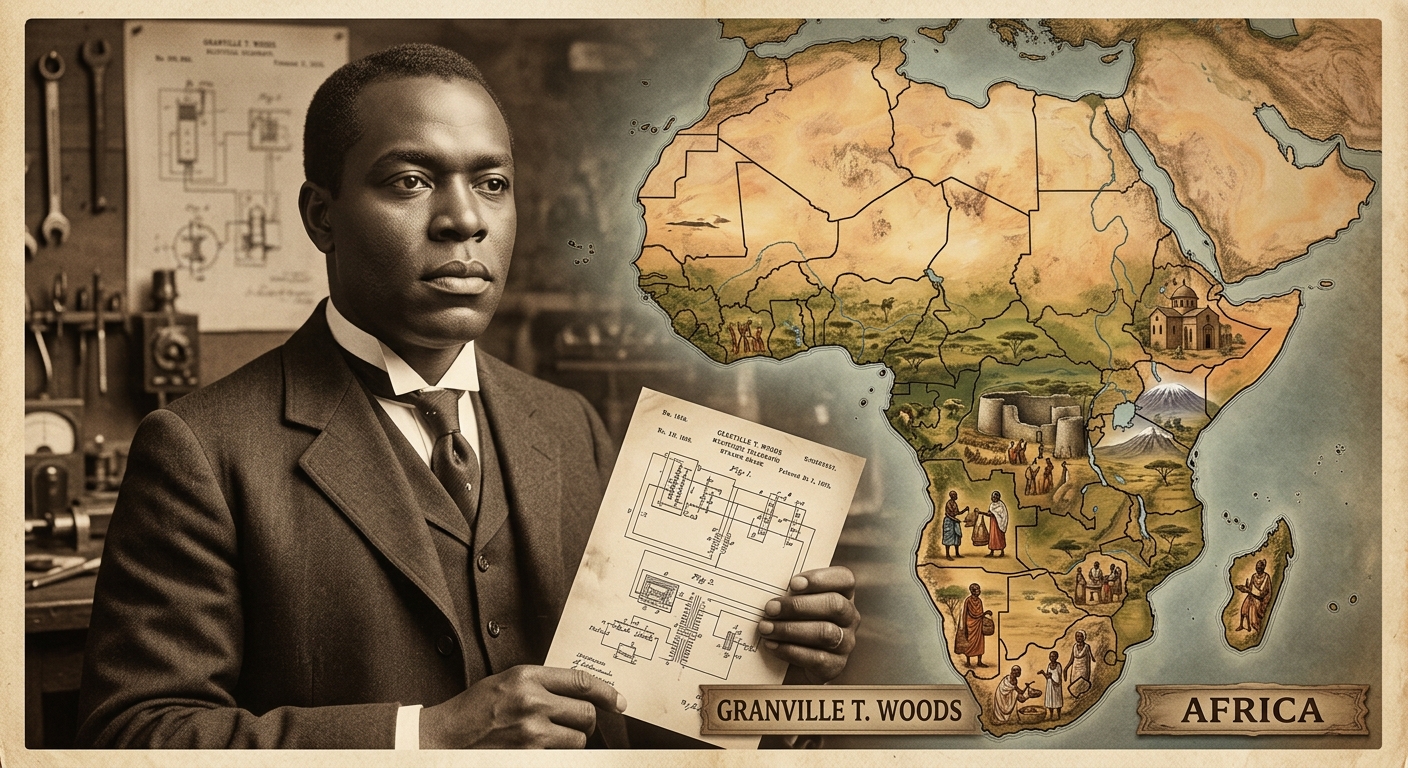
The example of **Granville T. Woods**, often referred to as the “Black Edison,” offers a powerful lesson about what happens when innovation exists without sufficient Political power behind a group of people and in this case black. Woods was a brilliant African American inventor whose work contributed significantly to the development of electrical and railway technologies. Yet throughout his career, he faced intense negative competition, patent disputes, and financial difficulties, including conflicts involving Thomas Edison. He died in relative poverty despite the enormous value of his inventions.
His story, together with the history of **Marcus Garvey, the Black entrepreneurs of Tulsa, Oklahoma, and the broader history of European descents purloining Africa’s natural resources**, points to a fundamental problem: **creativity and resources alone are not enough. They must be protected and controlled by Political institutions capable of defending the interests of the people who produce them.**
For centuries, Africa’s enormous mineral and natural resources have generated wealth for Europeans, Arabs and now Asians, some who are the richest in the African Continent today while too often leaving African societies with limited value addition, industrial capacity, technological ownership, and bargaining power. At the same time, many African markets have been treated primarily as dumping grounds for cheap, used, unwanted surplus, or lower-value goods rather than as the foundation for strong domestic industries and technological ecosystems.
This is why the African problem cannot be solved by **lamentation alone**.
Recognition of the problem is not enough.
Even just understanding the history is not enough in this age.
**Action is required—constant, organized, strategic, and relentless positive action.**
If Africans and People of African Descent are to change this historical pattern, we must build political power, strengthen our capacity for defense and security, this will be able to protect the developed African entrepreneurship, African inventions, build our own industrial and technological capabilities, and exercise far greater control over the resources and markets of our continent.
The lesson is not that Black people lack creativity or ability. History demonstrates the opposite.
The lesson is that **creativity without Political power can be exploited; resources without really sovereign states can be extracted and crippled markets without productive capacity can become dumping grounds.
This is precisely why I believe we must support the **African Continental Unity Party (ACUP)** and the broader effort to build institutions capable of transforming these ideas into practical action.
We cannot continue talking about the problems indefinitely.
**Lamenting is not enough. Recognition is not enough. Awareness is not enough.**
**We must rally. We must build. We must create. We must protect. And we must act—constantly and relentlessly—to break the cycle.**
That is the challenge before our generation.
**Africa must move from being a source of resources and a market for other people’s products to becoming a continent that owns its resources, builds its industries, develops its technologies, protects its interests, and creates prosperity for its own people.**
*Read more about Granville T. Woods, the inventor known as the “Black Edison,” in The New York Times’ profile.*
Ref:
Granville T. Woods, Inventor Known as ‘Black Edison’ – New York Times
Written with editing of Ai
